- Bitcoin institutions now hold 12.3% of the total supply, a 5% increase within a year.
- Bitcoin is shifting from retail dominance to becoming a key institutional reserve asset.
Bitcoin is witnessing a historic transformation as institutions rapidly increase their holdings, signaling a major shift in the market’s structure. What began as a retail-driven phenomenon is evolving into a new era where corporations, funds, and sovereign entities are becoming the dominant force behind Bitcoin’s supply and price dynamics.
Institutions Expand Their Share of Bitcoin
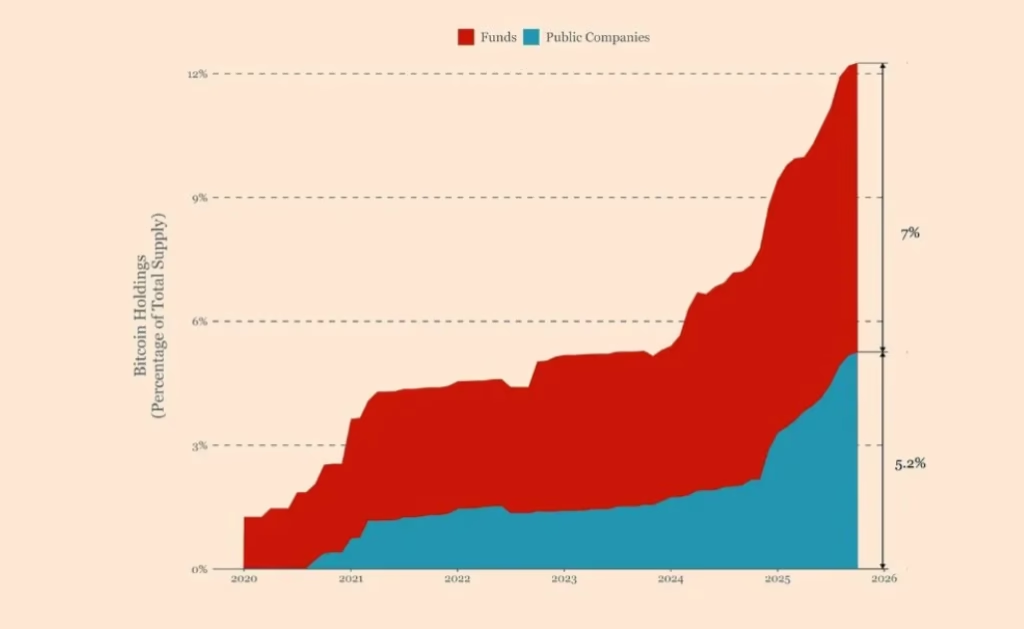
According to analytics platform Ecoinometrics, institutions now hold 12.3% of Bitcoin’s total supply, up nearly 5% in just the past year. This surge in institutional adoption coincides with Bitcoin’s impressive 80% price increase over the same period, highlighting the impact of large-scale ownership on market performance.
MILESTONE | Institutions Now Hold Over 10% of All #Bitcoin as Demand Outpaces Mining by 10x
This means institutional holdings have grown by more than 64% in the past year and by 27% in just the last six months.https://t.co/8dECuWGdTx $BTC pic.twitter.com/7XSRPtV41T
— BitKE (@BitcoinKE) July 25, 2025
Institutional holdings are spread across exchange-traded funds (ETFs), corporate treasuries, sovereign funds, and public companies. The most notable player, Strategy (formerly MicroStrategy), controls over 638,400 BTC—more than 3% of the total circulating supply. Japanese firm Metaplanet has also aggressively accumulated Bitcoin, surpassing 20,000 BTC in its reserves.
LIST | The 10 Public Companies With the Largest #Bitcoin Holdings as of April 2025
Below is a list of the top 10 public companies with the largest $BTC portfolios as of April 2025:https://t.co/jDlaeIoEJ4 @Bitcoin @BTC_Archive pic.twitter.com/f6kVp6HzLU
— BitKE (@BitcoinKE) May 18, 2025
Corporate and Banking Strategies Drive Accumulation
Institutions are not merely holding Bitcoin; they are building strategies around it. Many are issuing equity, restructuring balance sheets, and shaping operations to maximize exposure to the cryptocurrency as a reserve asset.
Major financial players are also entering the ecosystem. In 2025, JPMorgan began accepting Bitcoin ETF shares as collateral and partnered with Coinbase to enable Chase credit card users to purchase crypto directly. Such developments illustrate how traditional banking and corporate finance are intertwining with Bitcoin markets.
#Coinbase x #JPMorgan: A major signal for crypto’s future@jpmorgan now lets credit card users convert reward points into $USDC via @coinbase.
This is about who will dominate tokenized finance
Startups proved the vision.
Now giants are executing it.https://t.co/Nlel82p2Zu pic.twitter.com/vO7cL2nJnG— BitKE (@BitcoinKE) July 31, 2025
A Shift With Long-Term Implications
This consolidation of Bitcoin into institutional hands carries major consequences. Liquidity patterns are changing as early adopters and retail investors gradually exit, while corporations and funds take larger positions. On-chain data reveals declining exchange balances and address redistribution, evidence that institutional buyers are steadily securing Bitcoin’s fixed supply.
87% of #Bitcoin and Crypto Investments in 2020 Came from Institutional Investors, Dominated By Asset Managers, Latest Grayscale Report Reveals: https://t.co/JjW9VLpa1a @Grayscale
— BitKE (@BitcoinKE) January 15, 2021
With $7.5 trillion in money market funds potentially seeking better returns, Bitcoin could see even greater inflows of capital. If the trend continues, the narrative surrounding Bitcoin may shift permanently—from a grassroots asset driven by retail enthusiasm to a global institutional reserve instrument.
As institutions consolidate their holdings, Bitcoin’s market behavior, price stability, and long-term outlook are being rewritten. The cryptocurrency is no longer just a symbol of retail speculation; it is becoming a cornerstone in the strategies of the world’s largest financial entities.
DISCLAIMER:
The views and opinions expressed herein are solely those of the author and do not necessarily reflect the views of the publisher. The publisher does not endorse or guarantee the accuracy of any information presented in this article. Readers are encouraged to conduct further research and consult additional sources before making any decisions based on the content provided.
About the Author