- Bitcoin is under pressure below $73,000 due to ETF outflows and market uncertainty.
- Weak technical signals suggest further downside if support fails.
Bitcoin is facing renewed pressure as it struggles to hold above the $73,000–$75,000 range. Heavy ETF outflows, rising liquidations, and global uncertainty are weighing on sentiment. The market now sits at a critical decision point where either recovery or deeper losses could follow.
Bitcoin price weakens below key range
Bitcoin, widely tracked as Bitcoin, has dropped more than 5% over the past week. It recently traded near $73,300 after briefly touching a monthly low of $72,785.
At the moment, the $BTC retest of $73k has been successful despite recent downside volatility
If Bitcoin manages to Weekly Close above $73k then price will be one step closer to confirming the Double Bottom breakout & be positioned to try to trend continue#BTC #Bitcoin https://t.co/4da9Kzlx89
— Rekt Capital (@rektcapital) May 31, 2026
The coin now remains locked in a tight consolidation zone between $73,000 and $75,000. This range has become the key battleground for buyers and sellers.
Despite earlier strength, Bitcoin is still about 42% below its all-time high. This highlights how fragile the current recovery remains.
ETF outflows trigger fresh selling pressure
A major driver of the recent decline has been sharp institutional selling through spot Bitcoin ETFs. More than $733 million exited spot Bitcoin exchange-traded funds in a single session. A large share of this came from BlackRock’s iShares Bitcoin Trust, which alone recorded over $500 million in outflows.
These ETFs had previously supported Bitcoin’s rally by providing steady institutional demand. The sudden reversal removed a key price support layer.
Liquidations accelerate the downturn
The selloff deepened as leveraged positions were forced out of the market. Data shows more than $744 million in crypto positions were liquidated within hours. Around $715 million came from long positions.
When leveraged traders are forced to close positions, selling pressure increases quickly. This creates a chain reaction that pushes prices lower.
Macroeconomic uncertainty adds pressure
Outside crypto markets, global conditions are also weighing on sentiment. Geopolitical tensions near the Strait of Hormuz have raised concerns about energy supply disruptions. At the same time, oil price increases are fueling inflation worries.
Inflation readings in recent months have already complicated expectations around interest rate cuts. Investors now expect higher rates for longer.
This environment reduces appetite for risk assets, including cryptocurrencies like Bitcoin.
Technical outlook shows fading strength
From a technical perspective, Bitcoin is losing important support signals. The price is now trading below its key moving averages, including the 20-day, 50-day, 100-day, and 200-day levels. These indicators are clustered between roughly $75,800 and $81,000.
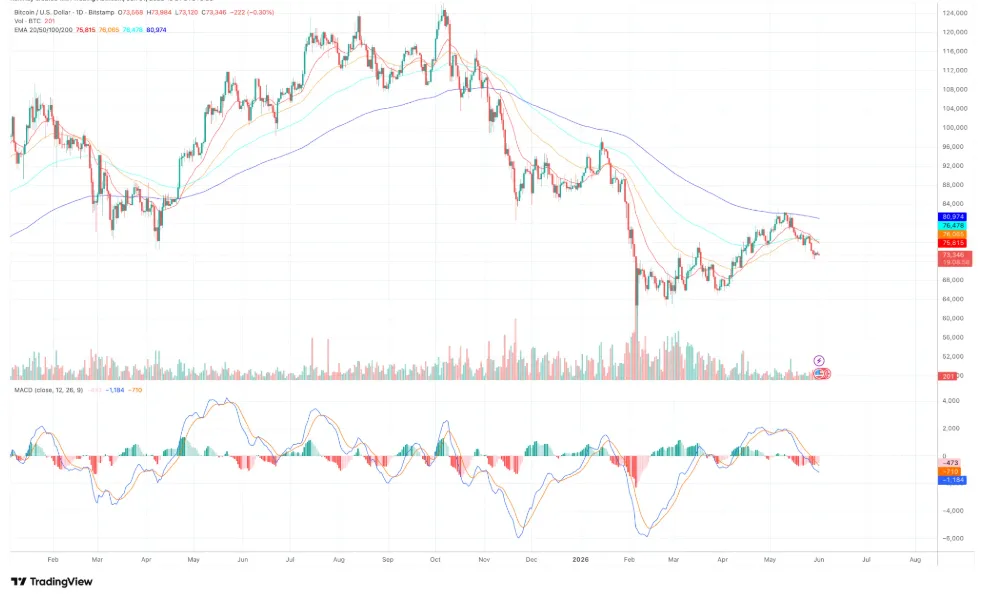
Momentum indicators have also turned weaker, with the MACD moving into negative territory. This suggests the recent recovery phase is losing strength.
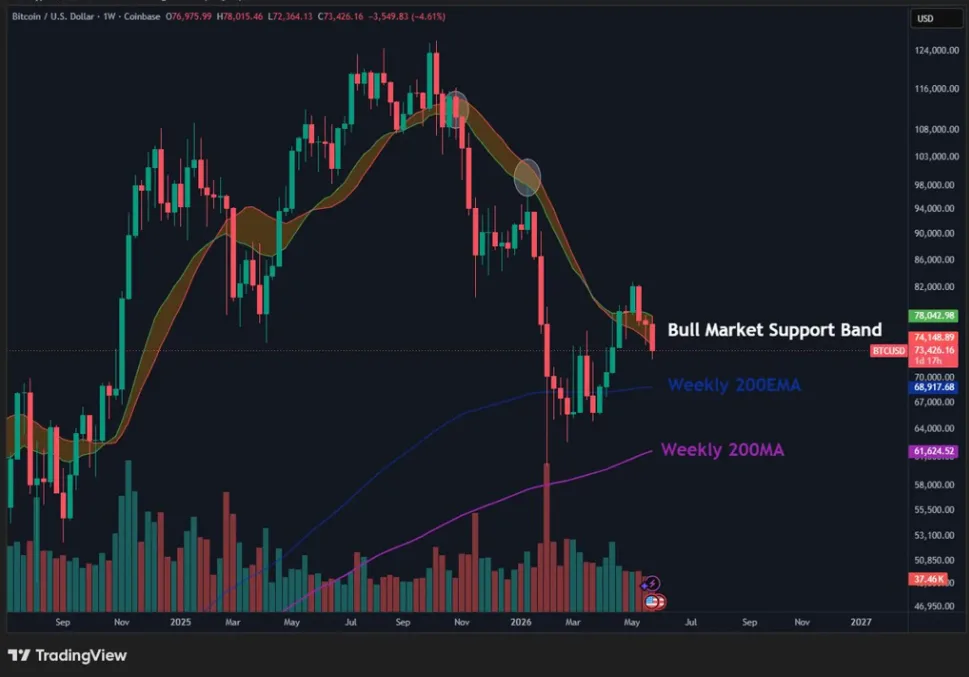
However, some analysts still point to a broader range between $60,000 and $80,000 as the dominant structure. This means Bitcoin may continue moving sideways if no strong breakout occurs.
Key levels to watch next
Bitcoin’s immediate support sits around $73,000. A sustained break below this level could open the door toward the upper $60,000 range. On the upside, a move back above the mid-$70,000 zone would be needed to restore bullish confidence. A stronger recovery would require clearing the major moving average cluster.
Bitcoin is at a critical point as ETF outflows and macro pressure test investor confidence. The next move around the $73,000 level will likely decide whether the market stabilizes or extends its decline.
ALSO READ: Pi Network Gaming App CiDi Games Hits 81K Users and 1.2M Game Sessions in One Week
DISCLAIMER:
The views and opinions expressed herein are solely those of the author and do not necessarily reflect the views of the publisher. The publisher does not endorse or guarantee the accuracy of any information presented in this article. Readers are encouraged to conduct further research and consult additional sources before making any decisions based on the content provided.
About the Author