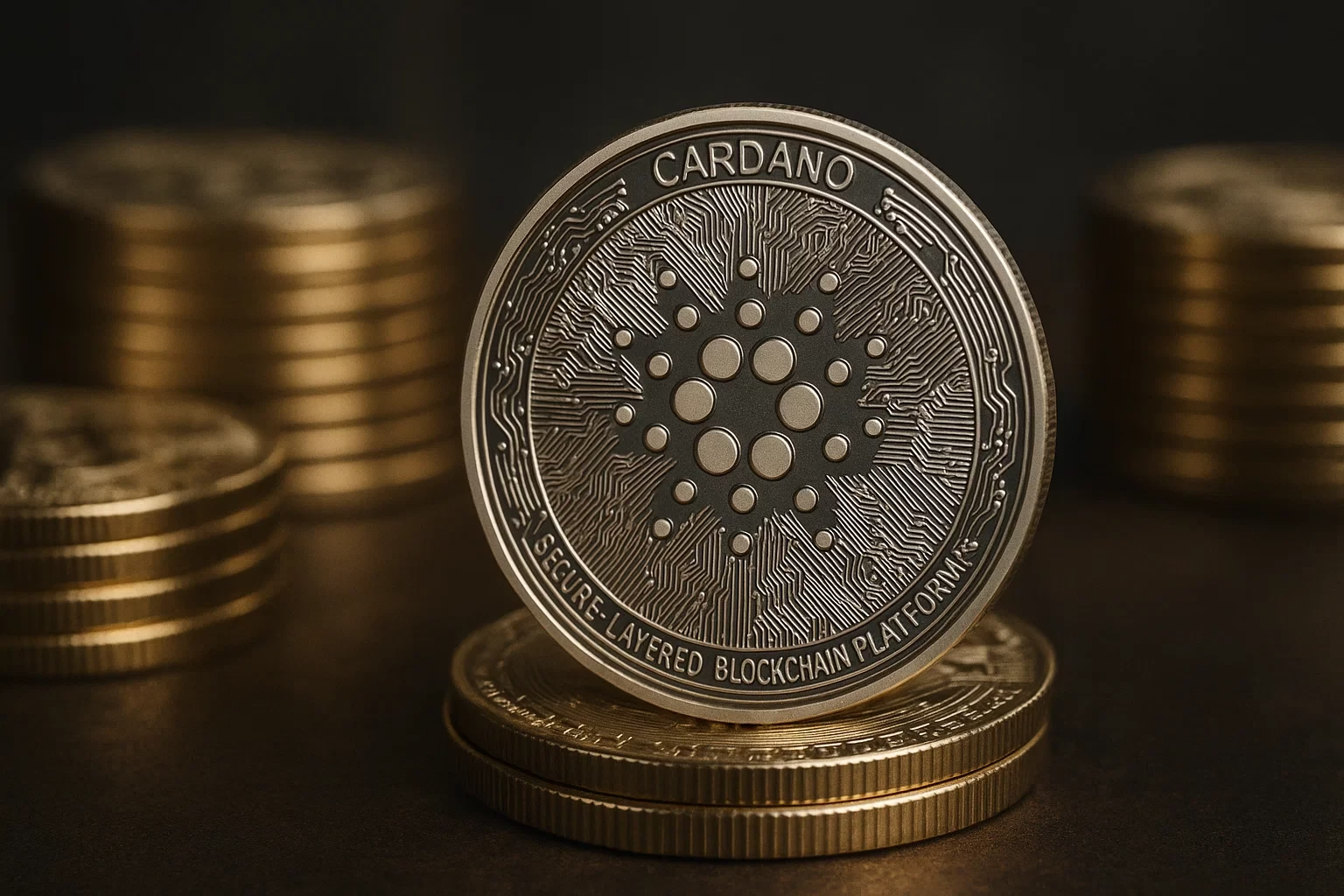
- Cardano brings smart contracts to Bitcoin without changing its protocol.
- ZK-proofs enable secure cross-chain DeFi.
- Bitcoin liquidity can now access Cardano applications.
Cardano’s Founder, Charles Hoskinson, revealed a major push to bring smart contract capabilities to Bitcoin using Cardano’s development tools. Unlike other approaches, this integration does not modify Bitcoin’s core protocol. Instead, Cardano leverages its infrastructure to allow developers to build Bitcoin-facing smart contracts securely and efficiently.
The initiative centers on the Plutus and Aiken programming languages and the BitVMX framework developed by Input Output Global (IOG). BitVMX enables complex contract logic to execute off-chain while Bitcoin transactions continue verifying outcomes on-chain. This ensures that Bitcoin maintains its security and efficiency while developers gain the flexibility to deploy advanced decentralized applications. Taproot developers, in particular, can now create hybrid apps that operate across both Cardano and Bitcoin environments, testing features before live deployment to reduce risk and shorten development cycles.
Zero-Knowledge Proofs Ensure Trustless Execution
Security remains a top priority. Cardano employs zero-knowledge proofs (ZK-SNARKs) to validate transactions across networks without relying on custodial bridges, which often introduce hidden risks. This cryptographic verification allows Bitcoin funds to move trustlessly into Cardano’s DeFi ecosystem, ensuring both security and transparency. By preserving Bitcoin’s foundational role as a store of value while extending programmability, this approach bridges innovation with stability.
Unlocking Bitcoin Liquidity for DeFi
Bitcoin holds the largest liquidity pool in the crypto market, yet most holders lack direct access to decentralized finance. Cardano aims to unlock this dormant capital by integrating Bitcoin into its DeFi platforms. Bitcoin-backed lending, decentralized exchanges, and yield strategies could emerge without using wrapped assets, enhancing capital efficiency and reducing custodial risk. Deeper liquidity benefits both ecosystems, improving market stability, pricing accuracy, and developer incentives for sustainable applications.
Hoskinson emphasized that this is a cooperative effort rather than a competitive one. Bitcoin continues to serve as the foundation for value storage, while Cardano provides the smart contract layer. The shared design principles, such as the Extended UTXO model, further simplify interoperability and make cross-chain innovation more accessible for developers.
Cardano’s move marks an important milestone in cross-chain development, offering a bridge between Bitcoin’s security and Cardano’s programmability. The potential for new financial products and broader DeFi participation is significant, signaling a new era of collaboration in the crypto space.
Might also like: Analysts Spot 2017 Pattern in XRP, Hinting at Upcoming Rally
DISCLAIMER:
The views and opinions expressed herein are solely those of the author and do not necessarily reflect the views of the publisher. The publisher does not endorse or guarantee the accuracy of any information presented in this article. Readers are encouraged to conduct further research and consult additional sources before making any decisions based on the content provided.
About the Author