- Chainlink CCIP enables secure cross-chain transfers using decentralized validation and strong safeguards.
- It reduces risks and supports large-scale institutional adoption.
Cross-chain communication has become a core requirement for modern blockchain systems. As more networks go live, the ability to move value and data across chains is now essential. This shift is not experimental anymore. It is infrastructure for global finance moving on-chain.
However, not all interoperability systems offer the same level of security. Many early cross-chain bridges have suffered from design flaws, centralization risks, and weak validation models. These weaknesses have already led to billions lost in exploits across the industry.
The Chainlink Cross-Chain Interoperability Protocol (CCIP) is built to solve this problem with a security-first design that focuses on decentralization, monitoring, and risk controls.
Why Cross-Chain Security Matters More Than Ever
The blockchain ecosystem now includes hundreds of public and private networks. These systems need to communicate to unlock liquidity and enable global asset movement.
But cross-chain bridges have often been the weakest point in Web3 infrastructure. Many rely on centralized operators or limited verification systems. This creates points of failure that attackers can exploit.
According to industry data referenced by Chainlink, nearly $3 billion has been lost in bridge-related hacks. This has slowed institutional adoption and raised concerns about safety in decentralized finance.
Without strong security guarantees, large financial institutions are unlikely to move significant capital on-chain.
Chainlink CCIP Built for Institutional-Grade Security
The Chainlink CCIP protocol was designed to address these challenges with a defense-in-depth architecture.
It is developed by Chainlink, a decentralized oracle network provider that has operated secure infrastructure for years across blockchain ecosystems.
CCIP is not a basic messaging layer. It is a full interoperability standard designed to meet institutional security expectations.
At its core, CCIP uses decentralized validation, independent node operators, and layered risk controls. This reduces reliance on any single point of failure.
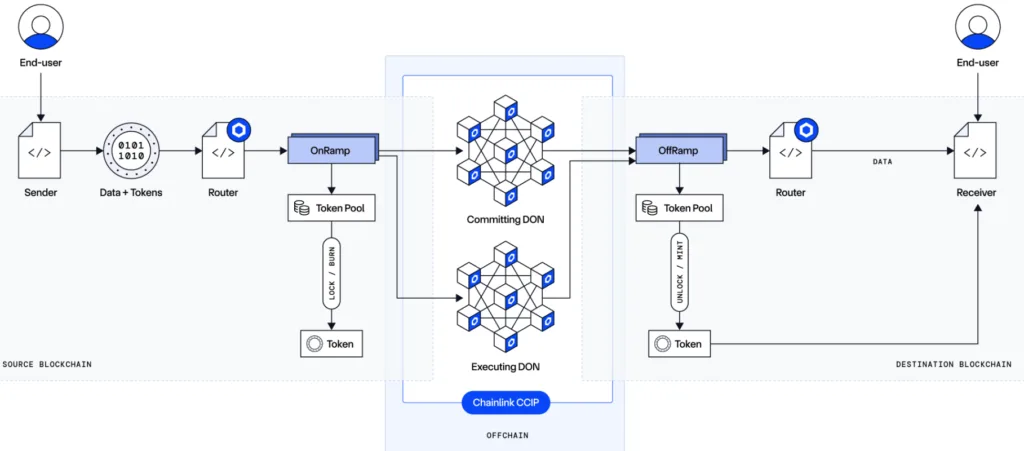
Decentralized Validation Across Independent Nodes
One of CCIP’s strongest features is its distributed network of nodes.
Instead of relying on a single bridge operator, CCIP uses multiple independent node operators that observe and validate transactions. These operators are geographically distributed and professionally managed.
They include security-focused infrastructure providers and Web3 DevOps teams with experience running critical systems.
This structure ensures that no single entity controls transaction verification. It also reduces risks associated with outages, corruption, or infrastructure failures.
Even during major cloud disruptions, CCIP has remained operational due to its diversified architecture.
Observation and Verification Work Together
CCIP separates the process into two key layers:
- Observation of events on the source chain
- Verification before execution on the destination chain
This matters because weak observation can allow invalid data into a system. If the input is wrong, the output becomes unreliable.
Many traditional bridge designs focus only on verification. CCIP strengthens both layers.
Chainlink’s decentralized oracle network model ensures that observed data is independently confirmed before execution happens.
This reduces the risk of manipulated or false cross-chain messages.
Built-In Risk Controls for Real Market Conditions
Financial systems must remain stable during extreme conditions. CCIP includes built-in controls designed for this reality.
These include:
- Rate limits that act as circuit breakers
- On-chain monitoring tools
- Issuer-level verification mechanisms
- Optional compliance enforcement tools
These features allow developers and institutions to manage exposure during abnormal market activity.
CCIP also supports the Chainlink Automated Compliance Engine, which enables policy checks before transactions are approved.
This makes CCIP suitable for regulated environments where compliance is required.
Eliminating Centralization Risks and Vendor Lock-In
Many cross-chain systems force developers to depend on specific infrastructure providers or embedded code structures.
CCIP avoids this problem.
It supports the Cross-Chain Token (CCT) standard, which allows tokens to move across chains without locking them into a single provider’s ecosystem.
Developers can:
- Use pre-audited token pools
- Build custom token logic
- Maintain full control over token contracts
This design ensures flexibility and long-term independence for asset issuers.
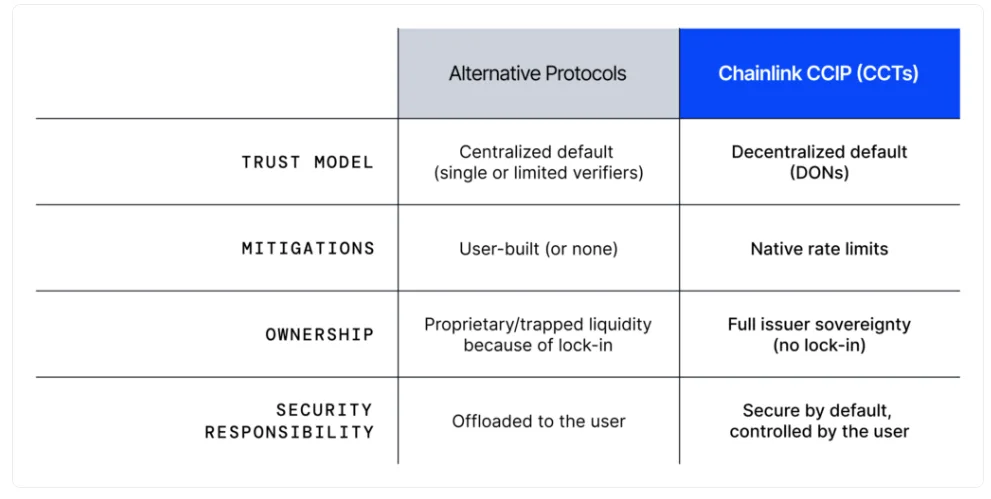
Proven at Scale Across Finance and DeFi
CCIP is already used in both institutional finance and decentralized finance.
It has been adopted in real-world systems involving global financial institutions, including partnerships connected to Swift, DTCC, and other major financial infrastructure providers.
Projects using CCIP include:
- Aave for cross-chain governance
- Lido for staking across networks
- Coinbase for wrapped assets
- Base for cross-ecosystem transfers
- Ondo for tokenized assets
It has also been used in central bank and financial market pilots, including cross-border settlement experiments involving major institutions.
These integrations show that CCIP is not theoretical. It is already in production use.
Why CCIP Stands Out in Cross-Chain Infrastructure
Most interoperability systems focus on speed or cost reduction. CCIP prioritizes security first.
Its key advantages include:
- Fully decentralized validation
- Independent node operator network
- Dual-layer observation and verification
- Built-in risk management tools
- Compliance-ready architecture
- No vendor lock-in for developers
This combination is designed to support both DeFi systems and regulated financial markets.
It also reflects the broader goal of enabling trillions in real-world assets to move safely on-chain.
Final Thoughts
Cross-chain infrastructure is becoming the backbone of blockchain finance. But security remains the most important factor for long-term adoption.
CCIP offers a structured approach that focuses on decentralization, resilience, and institutional-grade safeguards.
By combining secure validation, risk controls, and flexible token standards, it sets a higher benchmark for interoperability systems.
As more financial assets move on-chain, secure infrastructure like CCIP will play a central role in supporting global adoption.
DISCLAIMER:
The views and opinions expressed herein are solely those of the author and do not necessarily reflect the views of the publisher. The publisher does not endorse or guarantee the accuracy of any information presented in this article. Readers are encouraged to conduct further research and consult additional sources before making any decisions based on the content provided.
About the Author