- Solana trades near $86, stuck in a tight $84 to $87.50 range amid persistent technical weakness.
- Despite short-term selling pressure, rising institutional adoption and ETF activity support a more stable long-term outlook.
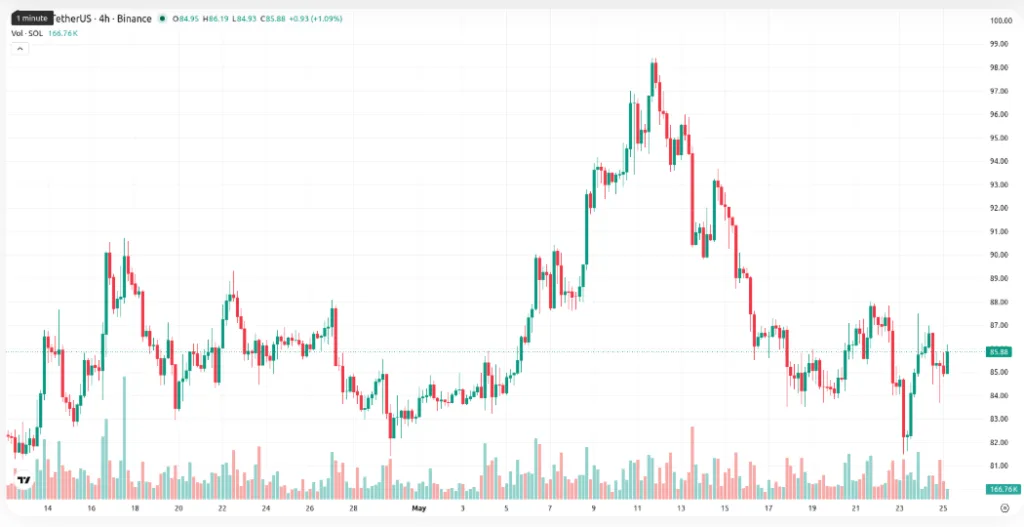
Solana is trading around $85.99 as the market remains stuck in a narrow range with weak short-term direction. Selling pressure continues to dominate price action, even as institutional adoption and network activity show steady growth beneath the surface.
Solana is currently down slightly on the day, reflecting a 0.15% decline. The price remains below key moving averages, which signals that the broader trend is still weak across short, medium, and long-term timeframes. Despite this, the asset continues to hold above its immediate support zone, preventing a deeper breakdown for now.
Price action remains trapped between $84 and $87.50
The market structure shows that Solana is consolidating within a tight range between $84.00 and $87.50. This zone has become the key battleground for traders as neither buyers nor sellers have been able to take full control.
A break below $84.00 would likely increase downside pressure and open the door to a further decline. On the other hand, a move above $89.91 would be required to signal a meaningful shift in direction and potentially restore short-term confidence.
For now, price behavior suggests indecision, with volatility remaining low and movement limited within this defined range.
Technical indicators continue to show weakness in trend strength
Solana is trading below the SMA-20 at $88.99 and the SMA-50 at $86.43, while also remaining well under the SMA-200 at $107.15. This positioning confirms that the market is still under longer-term bearish pressure.
Momentum indicators reinforce this outlook, with the MACD still in a sell condition and the ADX at 10.83, which reflects a very weak trend environment. At the same time, RSI and related indicators are hovering near oversold levels, which suggests that selling pressure may be slowing rather than accelerating.
Even though sellers remain in control, there are early signs that downside intensity is starting to fade.
Institutional adoption continues to strengthen the long-term outlook
Despite weak price performance, institutional engagement with Solana continues to grow. Major financial institutions, including JPMorgan’s blockchain division, have tested payment systems built on the Solana network, signaling real-world adoption beyond speculation.
The network also recorded record daily transaction volumes in Q1 2026, according to Messari data, highlighting strong usage and scalability under high demand. At the same time, VanEck’s Solana ETF recorded net inflows of $560,245, while Morgan Stanley refiled for a spot Solana ETF that includes a potential staking feature pending regulatory approval.
These developments suggest that institutional interest is building steadily, even as short-term price action remains under pressure.
Solana outlook shows consolidation with key levels in focus
The short-term outlook for Solana remains centered on consolidation rather than trend continuation. Price is expected to remain within the $84.00 to $87.50 range unless a strong catalyst triggers a breakout or breakdown.
A sustained move above resistance at $89.91 could signal a recovery phase and improve market sentiment. However, failure to hold $84.00 would increase the risk of a deeper retracement toward lower support zones.
Overall, the market remains balanced between weak technical signals and strengthening fundamental adoption.
Solana continues to trade in a tight range as selling pressure competes with growing institutional support. The price structure remains fragile in the short term, but network activity and ETF-related developments continue to support the long-term outlook. Traders are closely watching the $84 support level as the key area that could determine the next major move.
ALSO READ: A Silent Bitcoin Supply Crisis May Already Be Starting
DISCLAIMER:
The views and opinions expressed herein are solely those of the author and do not necessarily reflect the views of the publisher. The publisher does not endorse or guarantee the accuracy of any information presented in this article. Readers are encouraged to conduct further research and consult additional sources before making any decisions based on the content provided.
About the Author