- Cardano’s 2026 van Rossem Hard Fork will enhance Plutus performance, node security, and governance without a full era transition.
- The upgrade, alongside Ouroboros Leios progress, aims to improve scalability while enforcing disciplined treasury spending.
Cardano plans a major 2026 network upgrade that will spark discussion across the community. The proposal, presented by Intersect, outlines technical, governance, and scalability changes that could mark a turning point for the blockchain founded by Charles Hoskinson. At the center of the debate is Protocol Version 11, officially tied to what will be known as the van Rossem Hard Fork.
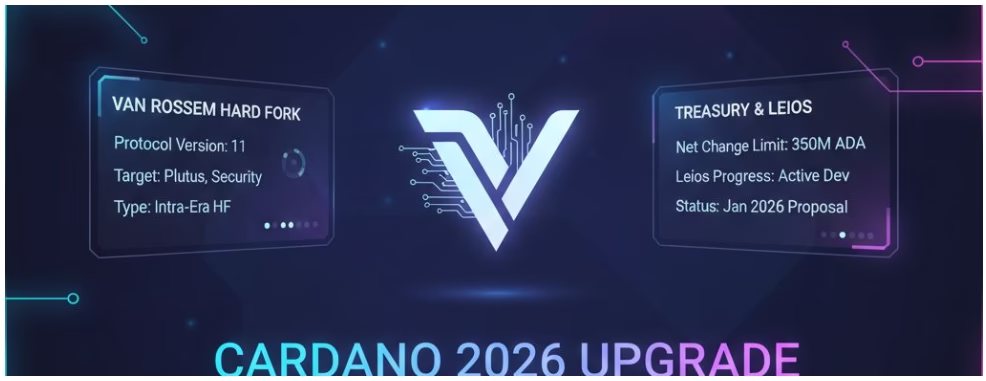
Intersect’s Hard Fork Working Group has put forward a proposal to name Cardano’s next upgrade – Protocol Version 11, the van Rossem Hard Fork, in honor of Max van Rossem.
View the proposal and vote here:
GovTool: https://t.co/04L4gUJXih
Cardanoscan: https://t.co/qGXSlHMEql… pic.twitter.com/mg2bXtbLX8— Intersect (@IntersectMBO) January 13, 2026
Named in honor of Max van Rossem, the upgrade follows Cardano’s tradition of recognizing individuals who have made lasting contributions to the ecosystem. However, beyond the symbolism, the proposal introduces practical changes designed to strengthen the network’s long-term competitiveness.
An Intra-Era Hard Fork With Practical Benefits
Unlike previous major upgrades, the van Rossem Hard Fork is classified as an “intra-era hard fork.” This means Cardano can introduce significant improvements without shifting to an entirely new ledger era. For node operators and developers, this approach reduces friction and lowers the complexity often associated with large-scale protocol changes.
The goal is to deliver meaningful upgrades while maintaining stability. By avoiding a full-era transition, the network can adopt improvements more smoothly, allowing participants to focus on building and operating rather than adjusting to disruptive structural changes.
Plutus Performance and Node Security in Focus
A core component of the upgrade is its technical impact on Plutus, Cardano’s smart contract platform. The proposal emphasizes improvements to Plutus primitives and reference input rules, which are expected to streamline smart contract execution. These enhancements aim to support more efficient decentralized applications while preserving ledger consistency.
Node security is another priority. Strengthening the security model is intended to improve resilience as the network scales and handles increasingly complex workloads. Together, these changes reflect Cardano’s emphasis on methodical, research-driven development rather than rushed innovation.
Governance and Treasury Limits Shape the Debate
Beyond technology, governance plays a central role in the proposal. Under the Cardano Constitution, a Net Change Limit of 350 trillion lovelaces, equal to 350 million ADA, has been suggested for treasury spending. This cap is designed to ensure fiscal discipline while still funding critical development work.
Supporters argue that such limits promote sustainability and transparency. Critics, however, question whether the cap could constrain innovation during a period of rapid ecosystem growth. This balance between caution and ambition remains a key point of discussion.
Looking Ahead to Ouroboros Leios
Running alongside the van Rossem Hard Fork is continued progress on Ouroboros Leios. According to IOG’s public tracker, specification and implementation work is advancing steadily. Once deployed, Leios is expected to significantly improve throughput, positioning Cardano to handle higher transaction volumes with greater efficiency.
As 2026 approaches, the van Rossem Hard Fork stands as more than a routine upgrade. It represents Cardano’s evolving identity in a competitive blockchain landscape, where governance discipline, technical refinement, and scalability must move forward together.
DISCLAIMER:
The views and opinions expressed herein are solely those of the author and do not necessarily reflect the views of the publisher. The publisher does not endorse or guarantee the accuracy of any information presented in this article. Readers are encouraged to conduct further research and consult additional sources before making any decisions based on the content provided.
About the Author